Why the Amber Alert Sound Is So Alarming
Where the Amber Alert tone comes from, why two frequencies a major second apart grate, why it beats your silent switch, and who Amber was.
Article
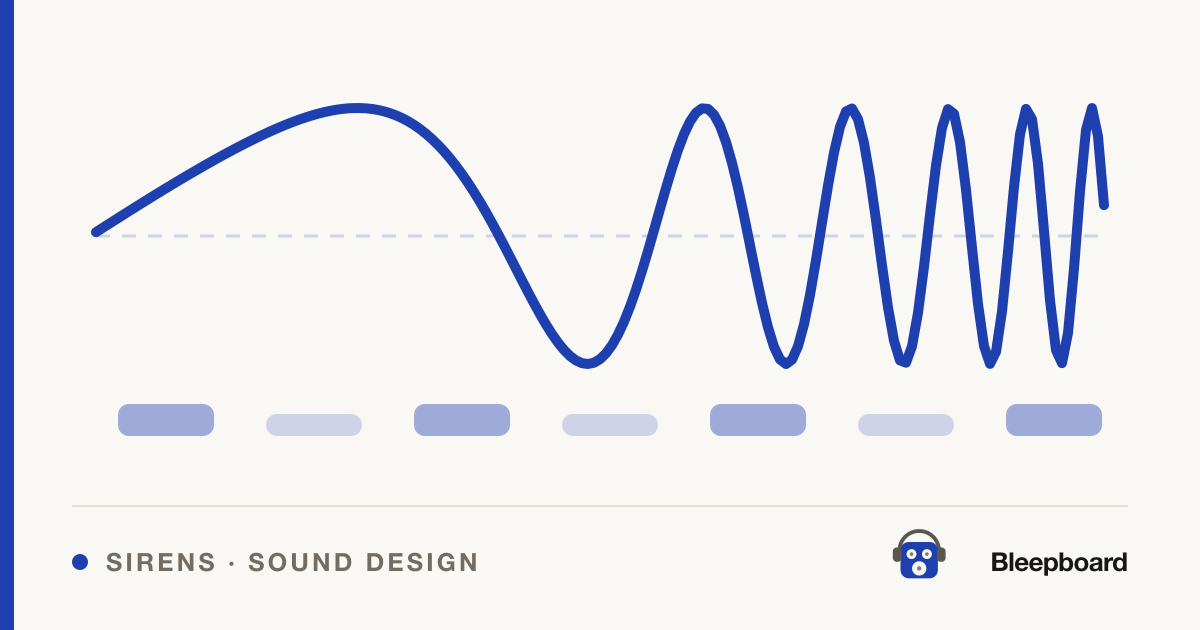
What each police siren mode means, why sirens are so hard to locate, where the low rumble comes from, and why hi-lo means evacuate in California.
The 2 sounds this article is about tap to play, free MP3
One siren, several different sounds, and the switching between them is not an officer fidgeting. A modern emergency vehicle runs one speaker off an amplifier carrying a handful of preset tones, and each tone exists for a different problem. Learn which is which and a passing siren turns into something you can read.
Wail is the slow one: a long sweep up and back down, a second or two per cycle. It carries furthest, which suits open road and distance, and it is the sound almost everyone pictures when they picture a siren.
Yelp is that same sweep run several times faster. Compressed like that it stops reading as a warning and starts reading as urgency, so it comes on close to traffic and at junctions.
Hi-lo, sometimes labelled phaser or piercer, alternates between two fixed notes rather than sweeping between them. Against a stationary queue of cars it cuts through better than a sweep does.
Air horn is the blunt instrument. It gets fired in short bursts over the top of whatever tone is already running, aimed at the one driver who still has not looked up.
Everybody has done the thing where you hear a siren, check three directions and find it in the fourth. That is not carelessness on your part. Traditional sirens work in a band of roughly 500 Hz to 1.8 kHz, and that band lands in an awkward gap for human hearing.
We locate low sounds mostly by the tiny difference in arrival time between our two ears, a cue that starts going ambiguous above about 1 kHz. Above that we lean on the difference in loudness between the ears instead, because your skull shadows the far one, but that cue is not pronounced enough to be much help below roughly 3 kHz. A siren tone sits at the bottom edge of the gap where neither mechanism is at its best. Then add a street of hard vertical surfaces throwing the sound around. Purpose-built directional sirens attack this by spreading energy across a much wider bandwidth, giving your ears more to work with.
Sirens have a physics problem in cities. High frequencies bounce off glass and steel rather than passing through, so a driver with the windows up and music on may honestly not hear one coming. Federal Signal’s answer, developed in 2007 and trialled by the NYPD that year, was the Rumbler. It listens to the main siren and re-emits it roughly two octaves down, in a band between about 182 and 400 Hz, through its own pair of speakers.
Low frequencies get through car doors and windscreens far more easily. They also shake things. Drivers describe feeling a Rumbler through the wheel and the seat before identifying it as a siren at all. It sounds for eight seconds and then shuts itself off, and it runs about ten decibels quieter than the siren it accompanies. Volume was never the point. Penetration was.
The alternating two-note hi-lo is standard across much of Europe and has always read to American ears as foreign. California gave it a second job. After the 2017 Tubbs Fire exposed how badly first responders needed a way to tell an entire street to leave immediately, the state passed Senate Bill 909 in September 2020, authorising emergency vehicles to use a hi-lo tone for that one purpose and no other.
Counties from Humboldt to Ventura have fitted it since. If you live in one of them and you hear that particular alternating note, it is not a patrol car passing through. It means go.
Before amplifiers and loudspeakers, a siren was a machine: a motor spinning a slotted rotor inside a slotted housing, chopping air into a tone. Federal Signal’s Q-Siren, designed in 1951, had become the default on American fire apparatus by the 1970s and is still fitted today, because a mechanical siren has a thickness that a loudspeaker struggles to counterfeit. It is also punishingly loud, and noise complaints have pushed some departments to retire theirs.
The police siren sound button gives you thirteen seconds, long enough to grab whichever section a video needs. There is also a generic siren wail that impersonates no real service, which is the safer pick if the clip is going anywhere public.
Both sit on the sound effects soundboard with the rest of the emergency kit. For the warning sound that arrives in your pocket instead of from a roof, the Amber Alert tone solves the same problem from the opposite end.
There are four presets. Wail sweeps slowly up and down across a second or two and travels furthest, so it suits open road. Yelp is the same sweep compressed, several cycles in the time wail takes one, which reads as emergency and gets used in traffic. Hi-lo, also sold as phaser, jumps between two held notes instead of sliding, and penetrates a stopped queue better. Air horn is punched over the top for the driver still staring at his phone.
Siren tones fall into a blind spot. Older sirens occupy roughly 500 Hz to 1.8 kHz. Below about 1 kHz we place sound using the minute delay between one ear and the other, and that cue blurs above it. Higher up we switch to the volume shadow cast by the skull, which contributes little until around 3 kHz. The siren sits in the trough between the two. Add a street of glass and brick bouncing it about and you are guessing.
A Rumbler, built for the city problem. Treble reflects off glass and steel instead of travelling through it, so a sealed car with music playing can genuinely miss an approaching siren. The unit takes the siren's signal, drops it two octaves to somewhere between 182 and 400 Hz, and sends it out of dedicated speakers. Bass walks through a car door. It also vibrates things. Eight seconds per burst, then it stops, and it runs around ten decibels below the siren proper.
Leave now. Senate Bill 909, passed in September 2020, licensed the hi-lo tone in California for evacuation orders and nothing else, a response to the 2017 Tubbs Fire and the discovery that nobody had a way to clear a street in a hurry. Agencies from Humboldt down to Ventura have since wired it in. Everywhere else the alternating pair is just the ordinary European siren, which is why it sounds foreign to American ears.
More from the same corner of the board. All free MP3 downloads.
Where the Amber Alert tone comes from, why two frequencies a major second apart grate, why it beats your silent switch, and who Amber was.
The iPhone's default alarm is called Radar. What it is, why the escalation works on you, whether it plays on silent, and how to change it.
How one line in an ericdoa freestyle became the Ninja low taper fade meme, why Ninja actually got the haircut, and whether it's really still massive.